

Stronger controls now govern changes to Term’s core lending protocol, supported by an independent audit and formal verification of the live Ethereum configuration.
Following the August vault incident, Term reinforced the permissions and safeguards used to administer its fixed-rate lending protocol. The upgrades strengthen the community veto, separate governance responsibilities, provide an emergency pause, and narrow authority over the TERM token.
Term’s core borrowing and lending contracts were not compromised in the August incident.
The August incident targeted the separate governance controls of the affected vaults. Deposits into those vaults were subsequently stopped, governance roles were revoked, and withdrawals remained open. Previous vault update.
Omniscia reviewed the new safeguards and checked their configuration on Ethereum. Its earlier audits of the Zodiac contracts used by Term made it a relevant choice for this work. The review covered both the safeguards and whether the live deployment reflected the documented setup. Read Omniscia’s final report.
Using Certora’s tools, Term also formally verified specified limits on governance authority. Those results were combined with reads of the deployed contracts, connecting the verified behavior to the Ethereum configuration. The sections below explain how the controls work together and the signer powers that remain. Explore the live governance proof.
The changes add an emergency stop for queued actions, lock the community veto to cancellation, and tighten the permissions used to change the protocol and TERM token.
The core lending contracts handle fixed-rate loans, collateral, repayments, and liquidations. Protocol governance determines who can authorize changes to those contracts, including upgrades and updates to collateral price feeds. The affected vaults had their own governance controls.
On Ethereum, authority for the most sensitive protocol actions is assigned to the OwnerlessSafe. Despite its name, this Safe has nine signers. Direct action requires unanimous approval. The standard process uses a separate proposing Safe and a public queue, with a 24-hour waiting period that was already in place before these upgrades.
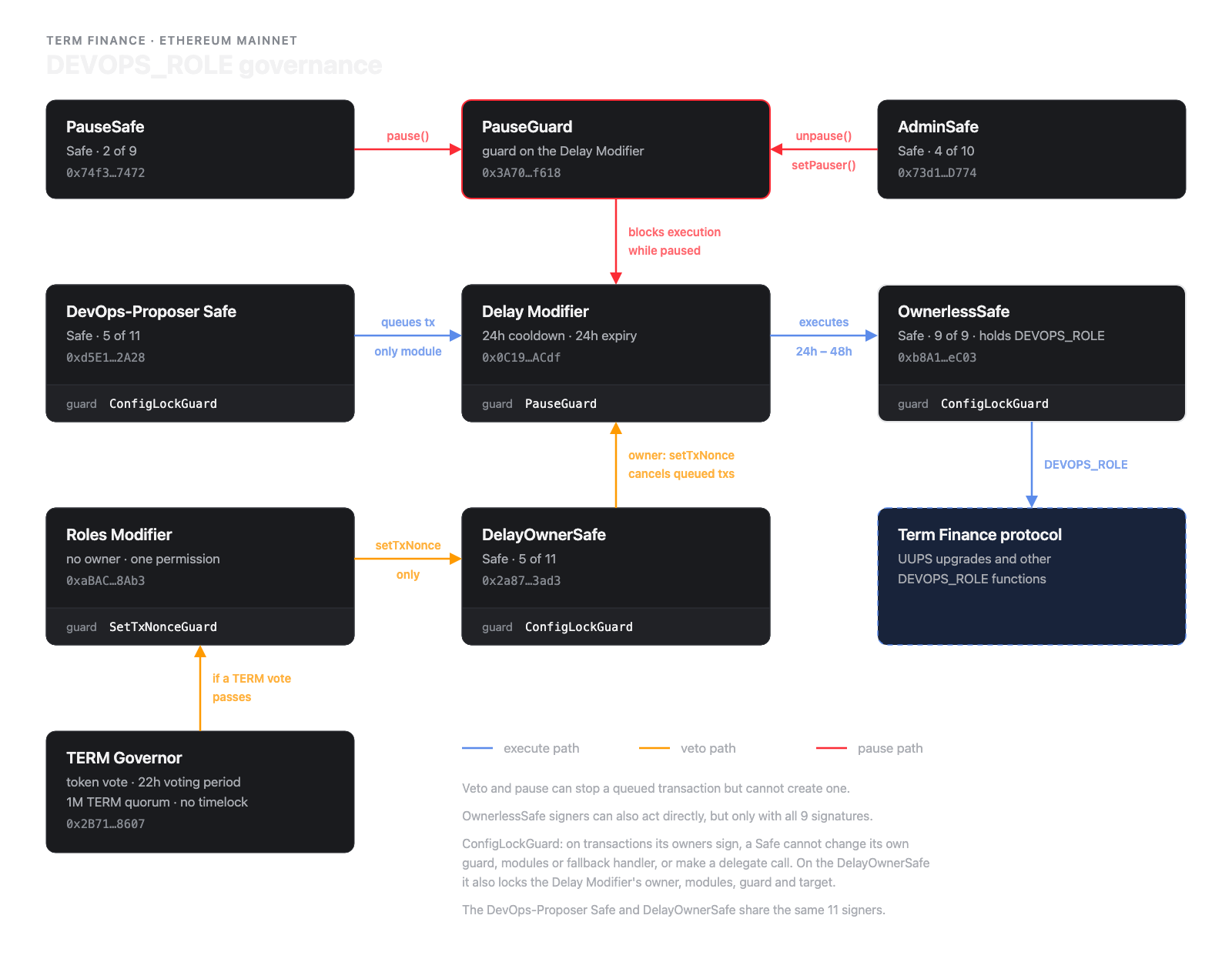
The developer documentation on upgradeability and access controls sets out the execution, veto, and pause routes, along with contract addresses and the settings each group can change.
Omniscia’s prior work on Gnosis Guild’s Zodiac codebase gave it relevant experience with the components Term uses. Omniscia (@Omniscia_sec) reviewed the custom safeguards and validated their live Ethereum configuration. Its final report recorded 15 findings, with Medium as the highest severity, and classified 13 as alleviated, one as acknowledged, and one as nullified.
Following that review, the TERM token was upgraded and emergency procedures were updated. Omniscia confirmed that the deployed token implementation matched the reviewed code. View the token upgrade transaction.
Using Certora's (@Certora) tools, Term verified properties covering execution authority, cancellation permissions, pause controls, and protected settings. The live proof records 309 passing checks, combining formal verification and on-chain evidence. Its conclusions apply to the specified properties under the documented configuration and assumptions.
The live configuration retains defined powers for trusted signers. All nine OwnerlessSafe signers can act directly without the queue. The DelayOwnerSafe can change the queue’s timing, and a separate four-of-ten AdminSafe controls unpausing and pauser changes.
Release 2.1.0 addresses the timing and pause-administration findings for future deployments by locking queue timing and assigning pause administration to the five-of-eleven ProposerSafe. Applying those changes on Ethereum mainnet would require a fresh deployment. Readers can inspect the safeguards in the live Ethereum configuration proof and follow each governance route in Term’s developer documentation.
Further governance updates will be shared through Term’s official channels, @term_labs and the Term blog.


